
Lake Stewards of Maine (LSM), together with Maine Department of Environmental Protection (DEP), York County Invasive Aquatic Species Program (YCIASP), and Little Ossipee Lake Association (LOLA), conducted a Level 3 Aquatic Invasive Species Survey on Little Ossipee Lake in Waterboro on May 22, 2024.
Why?
After swollen bladderwort (Utricularia inflata), an aquatic invasive plant, was discovered on Little Ossipee in late summer 2023, the Maine DEP and YCIASP assisted LOLA in finding the extent of the infestation during a so-called “Rapid Response” survey. LSM gathered together a crew of over 20 people to perform a full Level 3 Survey on Little Ossipee. The team consisted of staff from LSM, DEP, and YCIASP, along with volunteers from Little Ossipee Lake, Lake Arrowhead, Mousam Lake and beyond with LSM’s IPP Travel Team.
Breaking into small teams, the group set to work scanning every cove for swollen bladderwort. The search was fruitful, and together the teams discovered the aquatic invasive plant, already in flower, in its likely origin point in Eon Cove as well as scattered across the lake in shallow and protected areas. To document their findings, the volunteers and assisting staff used a Web tool called “Survey123” and paper survey forms, which were proofed, scanned, and submitted to the DEP by LSM.
Swollen bladderwort is one of the four “new” plants added to Maine’s invasive list in 2023. Originating in the lower eastern US, swollen bladderwort acts aggressively outside of its native range, and has been discovered and declared invasive in many Northeast States, as well as Washington State, and even overseas. Swollen bladderwort has been discovered on five lakes in Maine, including Little Ossipee, Mousam, Lake Arrowhead, Tilton Pond, and Horseshoe Pond (Chesterville).
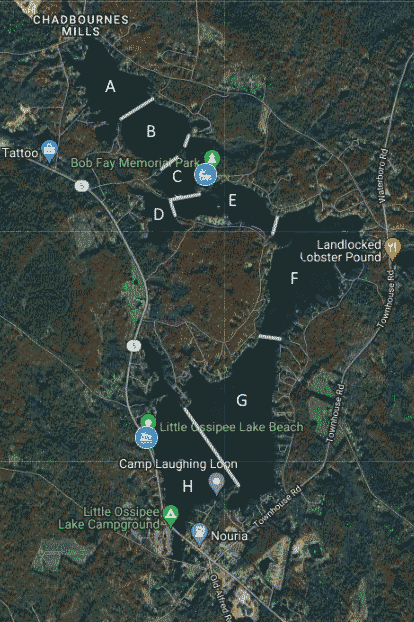
Following inspection of all the lake’s littoral areas (areas shallow enough to be illuminated by sunlight) with the exception of Eon Cove, swollen bladderwort was discovered in sectors B, C, and E (see map below). In Sector B, individual plants were discovered drifting in large numbers out of Eon Cove. In Sector C, larger patches of the plant were discovered on either side of the Bob Fay Memorial Park peninsula, with plants entangled around submerged logs. Plants found in Sector E were found drifting in deeper water, carried by wind. EON COVE APPEARS TO BE THE SOURCE OF THE INFESTATION. The infestation was mapped using Survey123. Found plants were removed, their locations marked with labeled buoys. It should be noted that, at the time of the survey, swollen bladderwort was blooming and easily visible. While in flower, the plant had developed floating rafts, allowing for easy wind dispersal.
Recommendations:
Maine’s DEP has developed a management plan with LOLA. The management plan includes hand-pulling and Diver Assisted Suction Harvesting (DASH), with a DASH boat visiting in early June 2024. Subsequent DASH operations were conducted in 2024 and 2025, and more are planned for 2026 as well. These operations are expensive, costing thousands of dollars each week, but their value is beyond price. LSM and YCAISP continue to support the Little Ossipee community with Live Plant ID training, and encourages LOLA to continue monitoring for aquatic invasive plants with its IPP Team.
Little Ossipee also has several Water Quality monitors, who are encouraged to continue their work. Considering its close proximity to Lake Arrowhead, our heavily-infested waterbody neighbor to the north, with 3 aquatic invasive species confirmed, LSM recommends continued thorough IPP monitoring, as well as Courtesy Boat Inspections at the public launch.